 Art
Art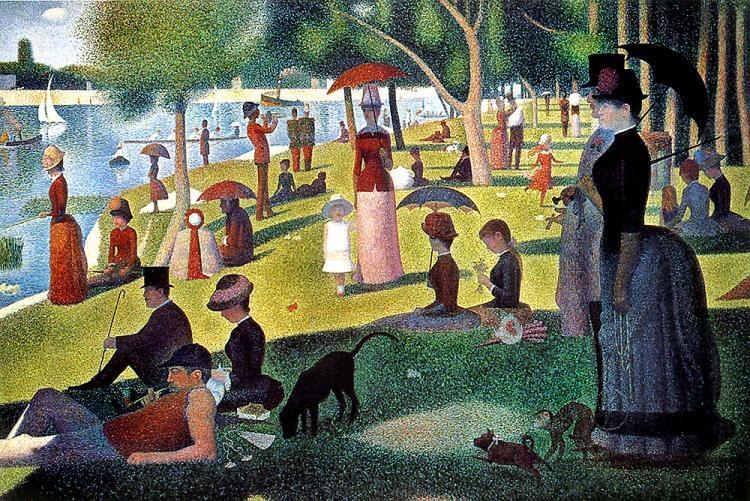
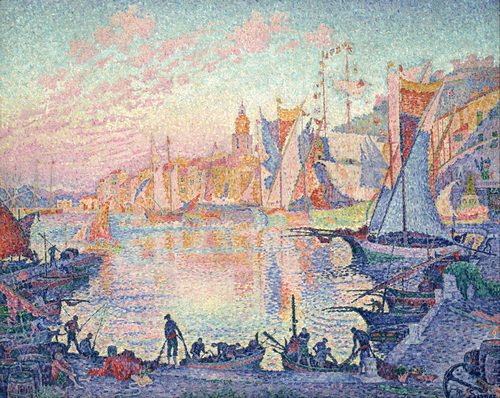
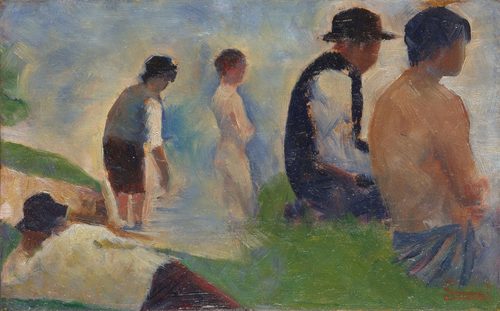
Pointillism is a painting method that builds an image out of small, distinct dots of pure, unmixed color instead of blended brushstrokes. Rather than mixing paint on a palette, the painter places tiny dabs of individual hues side by side and lets the viewer's eye do the mixing optically from a normal viewing distance, a principle drawn from color theory about how the eye averages adjacent colors. Up close the surface reads as a field of separate dots; step back, and the dots resolve into smooth gradients of light and shadow that can look brighter and more luminous than physically mixed paint, since optical mixing avoids the slight dulling that happens when pigments blend on a brush. The technique demands patience and planning, since every color relationship has to be worked out dot by dot in advance, and it rewards subjects with strong outdoor light, where the vibration of complementary colors can suggest shimmering atmosphere and sunlight.
How to spot it
- 01Surface made entirely of small, separate dots or dabs of color
- 02Colors that blend into gradients only from a normal viewing distance
- 03Complementary colors placed side by side to intensify each other
- 04No visible blending or gradation within individual dots
- 05Outdoor daylight scenes with a shimmering, granular quality
The Pointillism workshop card
weeks per canvas, given the dot countMaterials
- Oil or acrylic paint in a wide range of pure hues
- Small round brushes for consistent dot size
- Primed canvas or board
- Color wheel for planning complementary pairs
- Palette (used mainly for holding individual colors, not mixing)
- Magnifying glass or viewing mirror to check the piece from a distance
Steps
- 1
Plan the value structure first
Sketch the composition's light and dark masses before adding any color, since the dot technique makes correcting large value mistakes later extremely slow and difficult.
- 2
Choose a limited, pure palette
Select a set of unmixed hues straight from the tube rather than premixing on a palette, since the optical blending happens only when pure colors sit next to each other.
- 3
Work in small sections
Build the painting one area at a time to keep dot density and color relationships consistent, rather than jumping across the canvas, which makes matching earlier passages difficult.
- 4
Vary dot size with distance
Use smaller, tighter dots for foreground detail and slightly larger, looser ones for background areas, mimicking how fine detail naturally softens and simplifies with real optical distance in the eye.
- 5
Place complementary colors deliberately
Set colors like orange next to blue or red next to green in adjacent dots to intensify both through simultaneous contrast, the core optical trick behind the technique's vibration.
- 6
Step back constantly
Check the painting from several feet away throughout the process, since dot-by-dot color choices that look wrong up close often resolve correctly at normal viewing distance.
- 7
Keep dot application consistent
Hold brush pressure and dot shape steady across the whole canvas, since uneven dabs disrupt the even optical blend that makes the technique read as unified from a distance.
Classic mistakes
Mixing colors on the palette anyway
Premixing hues before dotting them down defeats the method's entire principle. Keep colors pure and let placement, not mixing, do the blending work in the viewer's eye.
Inconsistent dot size
Dots that vary wildly in size within one area create a patchy, uneven texture instead of a smooth optical blend. Keep size consistent within each zone of the painting.
Never checking from a distance
Working only up close leads to color choices that look right at arm's length but clash or muddy once the dots optically blend from across a room.
Underestimating the time required
Covering a full canvas dot by dot takes vastly longer than brushwork; rushing produces sparse, uneven coverage that never resolves into a convincing blended image.
Where it comes from
Pointillism emerged in Paris in the 1880s, developed by Georges Seurat working from contemporary color theory about optical mixing and simultaneous contrast, with Paul Signac as his closest collaborator and champion. The pair called their approach "divisionism" for the systematic separation of color into individual touches, while critics coined "pointillism" for the dotted technique itself. Seurat's large-scale canvases, built from methodically placed points applied over months, positioned the style as a scientific successor to Impressionism's looser broken color. After Seurat's early death, Signac carried the method forward and influenced later color-focused painters, though few artists sustained pure pointillism's demanding, slow, dot-by-dot process for long.
See it done perfectly
| Work | Maker | Date | What to look at |
|---|---|---|---|
| A Sunday on La Grande Jatte | Georges Seurat | 1884–1886 | Figures in a park built entirely from small, methodical dots of pure color. |
| The Papal Palace, Avignon | Paul Signac | 1900 | Architecture and sky rendered in bright, systematically placed complementary dots. |
| The Circus | Georges Seurat | 1890–1891 | Seurat's final, unfinished canvas, swirling circus motion built entirely from small dots of color. |
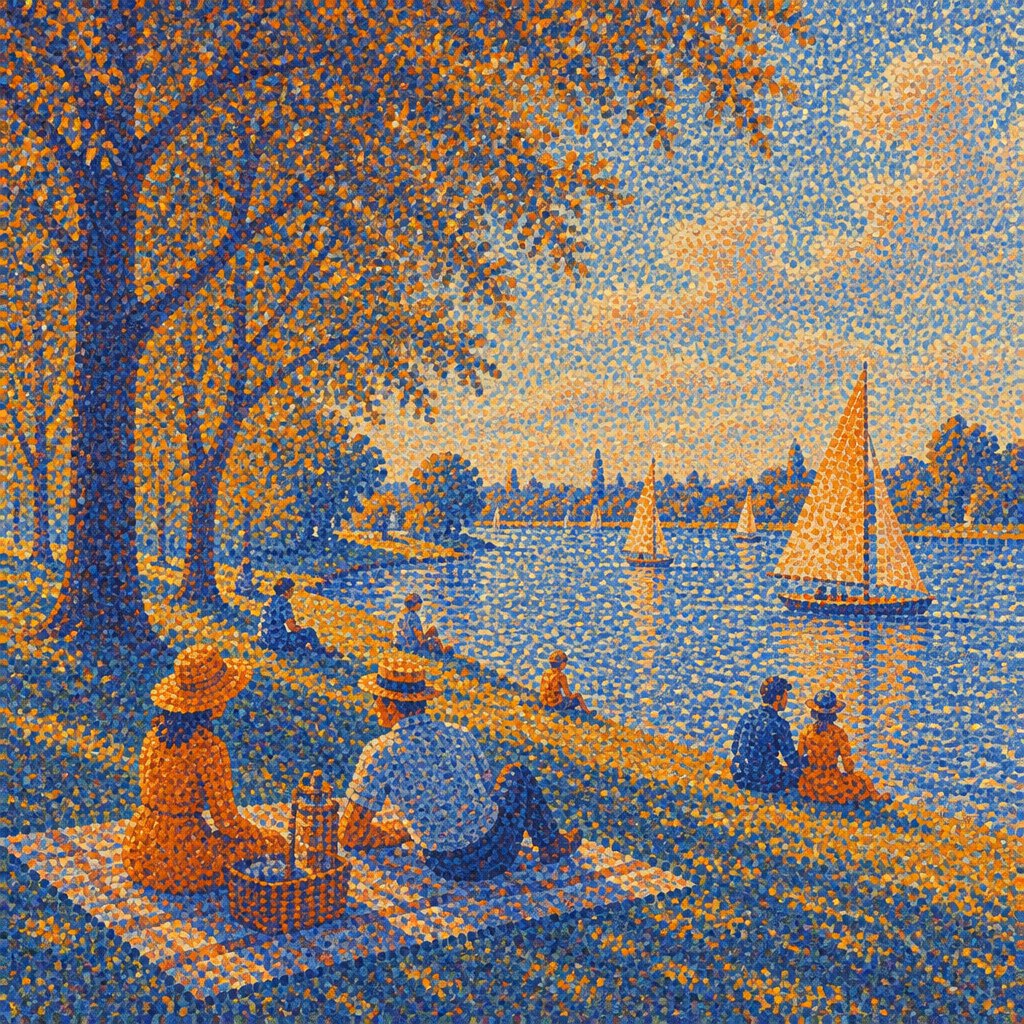 AI-generated
Try it with AI
Get the Pointillism look in a generator
To suggest this technique, describe a surface built entirely from small, distinct dots or dabs of pure, unmixed color, with no smooth blending. Useful vocabulary: dotted color field, optical color mixing, complementary color dots, granular pointillist texture, dabs of pure pigment, shimmering divided color, tiny uniform brush dabs. Naming outdoor daylight or dappled sunlight helps, since the style is strongly associated with sun-drenched, atmospheric outdoor scenes built from vibrating color pairs.
Frequently asked questions
What is pointillism?
Pointillism is a painting technique built from small, distinct dots of pure color placed side by side, which the eye optically blends into gradients and shapes when viewed from a normal distance.
What is the difference between pointillism and divisionism?
They describe the same core method; divisionism emphasizes the systematic separation of color into individual touches, while pointillism refers more specifically to the dotted application itself.
Can pointillism be done with acrylics?
Yes, acrylic's fast drying time actually suits pointillism well, since a painter can layer dots in quick succession without worrying about disturbing wet paint underneath.
Why do pointillist paintings look brighter than normal paintings?
Optical mixing in the eye avoids the slight dulling that happens when pigments are physically blended on a palette, so adjacent pure colors can read as more luminous together.